

Hana Greenfield
Counsellor (Bachelor of Counselling, PG Dip -Trauma Responsive Therapy)
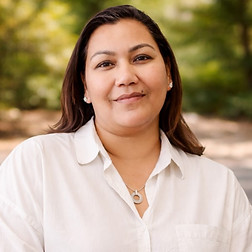
I currently have limited availability to accept private, online clients — including those who are drawn to shorter-term or more focused work. If my work resonates with you, do get in touch via the "Email Hana" button below — I'll be in touch as soon as I can.
Me
I was born and raised in southern India, have lived and worked across several countries, and now call Tāmaki Makaurau home. My own experience of trauma has taught me that remaking — and the pathway to re-emerging we are each invited to walk — isn't linear; it looks different for each of us, shaped by what we've each been carrying quietly.
My Mahi
I work primarily with women and femme-identifying people from racialised communities, with a focus on supporting women of colour and survivors of sexual violence, for whom this compounded trauma often arrives at the intersection of race, gender, migration, faith, and colonial conditioning to stay silent or conform. Often, this means navigating a lived reality in the context of communities that may not yet have the language or space to hold layered traumatic impact.
I'm an ACC registered, trauma-informed counsellor currently completing a Master's degree in trauma responsive therapy, shaped by feminist and Indigenous frameworks. I believe remaking isn't something that begins only after trauma — it begins within it, in the way the body responds in the very moment of impact. I've borrowed this word because of how it fits — it doesn't ask someone to go back to who they were, only to keep becoming who they already are. This is part of what shapes how I hold hope for those I sit with — that, even in the hardest moments, something within us is already underway, remaking itself with every breath. My approach leans on decolonising and anti-pathologising practices — ways of working that ask not what's wrong with someone, but what happened, and within what systems of power and harm — so a client's experience and narratives can be understood for what they actually are.
When you work with me, we will find space for more than words. Alongside talk therapy, we may slow down to notice what's happening in your body, work with different parts of yourself that carry different feelings, pay attention to the patterns that show up in relational spaces, or use Brainspotting to help process what feels too big for language alone — because trauma's deepest impact often isn't held in the words or the story, but in the body, the nervous system, and the relationships we live. I'm currently working toward Somatic Experiencing certification, to deepen my practice as a somatic therapist.
My Mahi, Beyond the Therapy Room
My work in the areas of clinical practice, research, and advocacy inform each other. I research resilience, sexual violence, and culturally responsive trauma care, with particular focus on language that resonates with survivors in faith-oriented communities, where shame, forgiveness, and restoration carry cultural and spiritual weight that mainstream therapy often misses. I also contribute to advocacy through a national body representing minoritised ethnic communities, working toward systemic change that serves those most marginalised within existing structures.
My Commitment
I hold myself accountable in each of my spheres of work, through rigorous supervision and sustained personal therapeutic work. I believe that the quality of presence I bring to a session is inseparable from the quality of care I receive myself. I hold the therapeutic relationship itself as a place of relational repair — one that helps build internal stability, self-trust, and capacity for connection over time.
"Trauma is a Greek word for wound. Literally that's what it means. So when you understand that, then you realize...trauma is not what happens to you. Trauma is what happens inside you as a result of what happened to you.
....Trauma is not the event that inflicted the wound. So, the trauma is not the sexual abuse, the trauma is not the war. Trauma is not the abandonment. The trauma is not the inability of your parents to see you for who you were. Trauma is the wound that you sustained as a result.
....So my wound wasn't that my mother gave me [away temporarily] to a stranger [when I was a child]. My wound was that I made that mean that I wasn't lovable and I wasn't wanted and I was being abandoned, which is a good thing. Because if the trauma was what happened to you, guess what? It'll never unhappen.
....But if the trauma wound happens inside you, the wound that you're carrying? That can heal at any time."
- Dr. Gabor Maté
“Trauma decontextualized in a person looks like personality. Trauma decontextualized in a family looks like family traits. Trauma decontextualized in people looks like culture.”
- Resmaa Menakem
